

By Gemma Flora Ortwerth | June 15, 2025
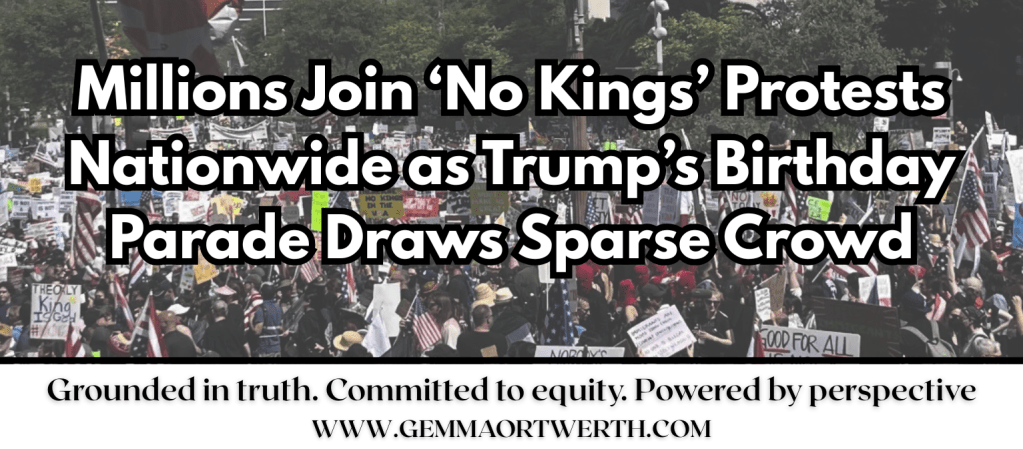
A large protest crowd holds signs and American flags during a “No Kings” rally.
On Saturday, June 14, Americans in cities across the country mobilized in what organizers called the largest coordinated protest of the year. Branded the “No Kings” rallies, the grassroots-led demonstrations were held in over 2,000 locations, with organizers claiming over 2 million participants nationwide. Preliminary estimates from local police departments ranged from 800,000 to 1.2 million, though full counts remain pending.
The protests were organized in response to President Donald Trump’s 79th birthday and a military parade held in his honor in Washington, D.C. Protestors framed the day as a rejection of what they described as authoritarian symbolism and escalating state power.
In contrast, the President’s parade drew a notably sparse crowd. Aerial footage from multiple media outlets showed numerous empty bleachers along the parade route. Two unnamed civilian staffers within the administration, speaking on condition of anonymity, described the event as “mandatory” for many federal attendees and “uncomfortable” in tone. The Department of Defense did not respond to a request for comment on either attendance figures or internal participation requirements.
While Trump’s event emphasized military might, the “No Kings” protests emphasized democratic accountability. In Los Angeles, where protestors marched through downtown, tensions escalated when law enforcement deployed tear gas and rubber bullets. The American Civil Liberties Union and the NAACP condemned the response, calling the use of force excessive and the deployment of the National Guard a “troubling normalization of domestic militarization.”
Videos verified by Reuters and Amnesty International documented incidents where minors were detained. Several were later released without charges. The Los Angeles Police Department stated that officers were responding to “crowd safety concerns” and acting in accordance with protocols for unlawful assembly dispersal. An internal review of specific incidents, including those involving minors, is reportedly underway.
Major cities including Atlanta, Chicago, Baltimore, and Denver also saw significant turnout. Protestors in these cities called for a range of reforms—immigration justice, racial equity, LGBTQ+ protections, labor rights, and disability inclusion among them. Though decentralized in structure, the rallies were unified in message: a broad resistance to concentrated power and the erosion of democratic norms.
“This is not about partisanship. It’s about the survival of democracy,” said Amira Jackson, a 27-year-old organizer with a mutual aid network in Minneapolis. “When power is hoarded and dissent is punished, the people have no choice but to reclaim the streets.”
Trump’s recent public praise of leaders such as Hungary’s Viktor Orbán and Russia’s Vladimir Putin has drawn international scrutiny. Civil rights organizations and political analysts alike warn that increasingly centralized executive authority, paired with state-sponsored spectacle, carries dangerous historical parallels.
Dr. Lila Romero, a political historian at Howard University, noted, “When public servants describe ceremonial events as burdensome, it signals institutional stress. Democracies don’t require loyalty displays—they earn trust through accountability.”
The White House dismissed the protests as “a fringe movement out of touch with patriotic Americans.” A spokesperson stated that the President “remains focused on honoring the military and delivering results for the country.” The Pentagon said participation in the parade was “voluntary and consistent with long-standing traditions.”
Despite the administration’s efforts to project unity and strength, the images from Saturday painted a more fractured picture. On one side of the Capitol, tanks rolled and flags waved before a half-empty grandstand. On the other, millions across the country held handmade signs, sang protest songs, and reminded the world that power, without consent, has no mandate.
For organizers of the “No Kings” movement, Saturday was not just about resisting one leader. It was a collective statement that authoritarianism—no matter how it’s branded—has no place in a functioning democracy.
 Gemma Ortwerth
Leave a comment