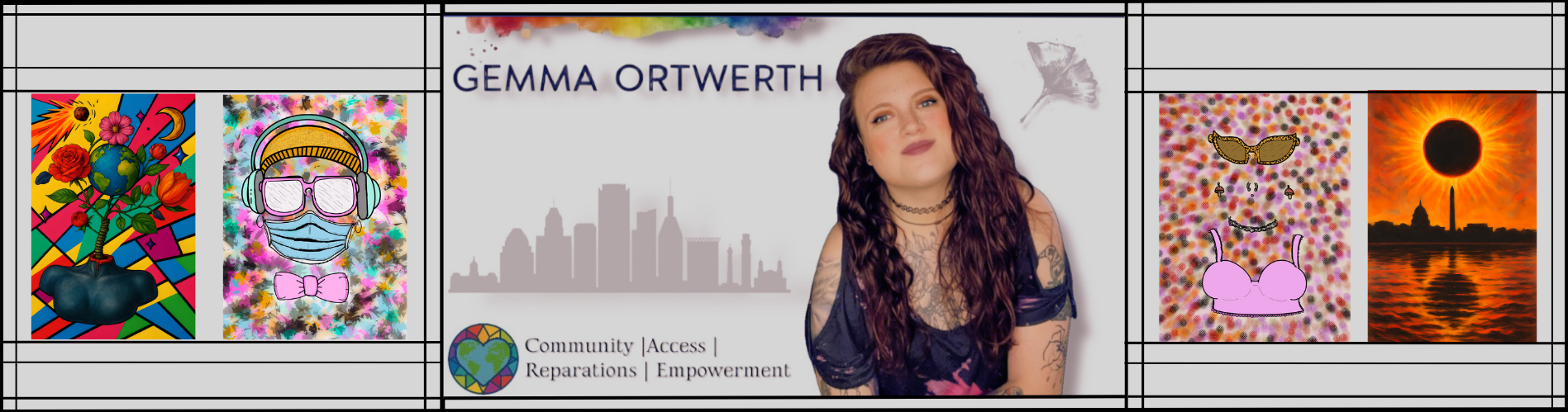

By Gemma Flora Ortwerth

Conservative ideology in the United States presents itself as a defense of tradition, family values, and moral order. But peel back the carefully curated language and what becomes clear is that these values are built not on justice or truth, but on fear, control, and the preservation of hierarchies that harm the most vulnerable. As a queer, disabled, autistic, trans woman, an activist, artist, and future social worker, I have lived through the consequences of this ideology. I do not critique it from the sidelines—I exist in spite of it. And every day, people like me are forced to prove our humanity in a system that was never built to include us.
Fear, Control, and Manufactured Morality
At the heart of conservative thought lies a deep fear of difference. Whether it’s race, gender, sexuality, disability, or neurodivergence, conservatism often responds not with curiosity or compassion but with suspicion and rejection. Rather than adapt to a changing world, conservatives cling to rigid structures—family, nation, church—as if those concepts were ever neutral or just. But these structures have always been selective, violent, and exclusionary.
Take anti-LGBTQ sentiment, for example. Conservatives frame queer and trans existence as a threat. But queer people simply existing is not a threat. Love is not a crime. Being yourself harms no one. What does harm is shaming children, banning books, and using religion to justify hate. What does harm is stripping healthcare from trans youth, pushing families into fear and silence, and turning our bodies into battlegrounds for someone else’s dogma. The cruelty is not incidental—it is the strategy.
The Myth of Morality and the Gospel of Hypocrisy
Christian dogma plays a central role in conservative ideology, not as a source of healing, but as a tool of domination. It claims to be rooted in love, yet it shames those who question, threatens eternal punishment, and demands blind obedience. It preaches humility while hoarding wealth and power. It lifts up the name of a brown-skinned revolutionary while supporting politicians who criminalize poverty and dehumanize immigrants.
True morality is not about forcing others to comply with your beliefs. It is about meeting people where they are, honoring their agency, and helping them live with dignity. Yet conservative movements across the country have pushed laws that do the opposite—banning gender-affirming care, restricting reproductive rights, and erasing the history and voices of marginalized communities. These are not acts of faith. These are acts of fear, dressed up as righteousness.
The Weaponization of “Life” and the Myth of Protection
The “pro-life” movement is another key pillar of conservative ideology, and it collapses under the weight of its own contradictions. If it were truly about protecting life, it would support universal healthcare, paid family leave, childcare, housing assistance, and mental health services. Instead, it supports forced birth while slashing food stamps, opposing gun control, and ignoring maternal mortality. It values embryos over actual lives.
As a future social worker and someone who lives with chronic illness and pain, I know firsthand that pregnancy is not just a private moral issue—it is a medical, emotional, and economic one. People die in childbirth. People lose their homes, jobs, and mental health. For disabled people, queer people, and people of color, these risks are even higher. Yet the “pro-life” agenda pushes forward without care or nuance. Forced birth is not compassion. It is state-mandated suffering framed as virtue.
Philosophically, this stance fails. You cannot claim to value life while denying bodily autonomy. You cannot call it moral to turn a living, breathing person into a vessel for someone else’s potential. Ethics without compassion are just rules for controlling others.
The Autism-Vaccine Lie and the Fear of Neurodivergence
Nowhere is this fear of difference more clearly exposed than in the enduring myth that vaccines cause autism. That claim came from a fraudulent study by Andrew Wakefield, whose license was revoked for falsifying data. Yet the lie persists because fear spreads faster than truth. The core of the myth is not concern for children—it is a fear of people like me. It is ableism disguised as advocacy.
As an autistic person, I have watched this narrative unfold with deep frustration. The problem is not that people believe something incorrect. The problem is that they treat neurodivergent lives as so undesirable, they would rather risk deadly disease than accept us. Autism is not a tragedy. It is a neurotype. It is a different way of experiencing the world. And the real harm does not come from vaccines. It comes from the way society refuses to see our value.
If we truly care about protecting children, we must start by accepting all of them, not just the ones who fit a narrow mold. We must stop using fear to justify exclusion and start building a world where every kind of mind is valued.
Guns, Death, and the Myth of Freedom
Conservatives often frame gun ownership as the ultimate symbol of freedom. But guns were not made to symbolize anything. They were made to kill. No other object is designed solely to end life. And the data is clear: more guns do not make us safer. Countries with stronger gun laws have fewer deaths. In the United States, children now do lockdown drills because adults refuse to let go of their obsession with weapons.
Gun reform is not about control. It is about survival. The refusal to pass basic safety laws is not about rights. It is about power and profit. It is about the illusion of safety for some while the rest of us live in fear. To claim to be pro-life while defending assault rifles is a level of hypocrisy only possible in a system that values ideology over human lives.
Immigration and the Manufactured Enemy
Conservative rhetoric around immigration reveals another layer of fear-based control. The United States was built by immigrants on stolen land. No one is illegal on land taken by force. Yet immigrants are blamed for the failures of capitalism, for underfunded schools, for economic insecurity that was created by corporate greed and policy decisions.
Immigrants pay taxes. They start businesses. They keep entire industries running. And yet they are vilified while billionaires hoard wealth and politicians deflect blame. The problem is not immigration. The problem is racism, xenophobia, and the refusal to share power. It is easier to create an enemy than to fix the system. And conservative ideology thrives on that distraction.
Equity Is Not Radical
The one consistent thread across all of this is the conservative fear of equity. Whether it’s trans rights, disability rights, economic justice, racial justice, or reproductive freedom, conservatives consistently push back—not because equity is wrong, but because it threatens their hold on power.
Equality feels radical to those who have never had to share. Compassion feels threatening to those who have built their comfort on someone else’s oppression. But I will say this clearly: equity is not an attack. It is a necessary correction. And fighting for it is not extreme. It is survival.
Thriving Without Permission
I cook. I bake. I write. I paint. I build community. I advocate. I attend grad school. I am not rich. I do not work a 9-5. But I am thriving. I am claiming joy in a world that tried to deny me existence. I am autistic, queer, disabled, and trans—and I am powerful. Not because I am exceptional, but because I am allowed to be whole.
That is what conservative ideology fears the most. People living fully without their permission. People building lives that do not follow their rules. People like me, existing loudly, joyfully, and unapologetically.
To those who are still clinging to conservative dogma: you are not protecting anything. You are preserving harm. And we will not go quietly. We will write, we will speak, we will love each other fiercely, and we will win. Not because we want to dominate—but because we believe everyone deserves to breathe, to dream, to be free.
And that belief is far more powerful than your fear.
 Gemma Ortwerth
Leave a comment