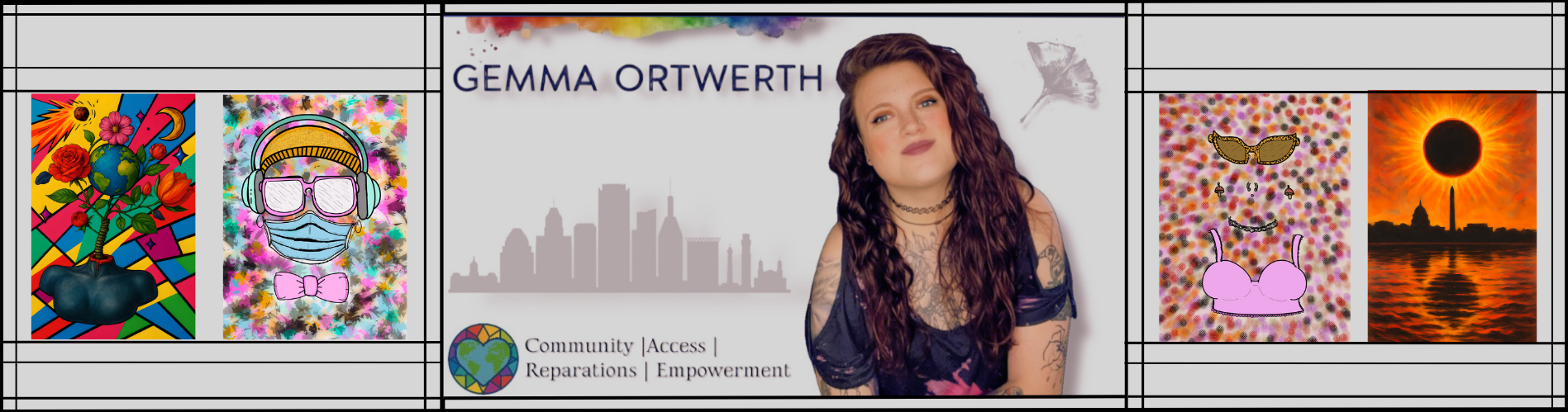

By Gemma Flora Ortwerth

I am a trans, autistic woman living with chronic pain, congenital heart disease, osteoporosis, complex PTSD, and the lingering impact of a childhood stroke. My teenage years were shaped by instability at home and a desperate need for safety and structure. I turned to school for support, for some kind of refuge. But what I found inside Montgomery County Public Schools was something else entirely. It wasn’t protection. It was punishment.
In ninth grade, I was placed in both the Humanities and Engineering magnet programs at Poolesville High School. They were brand new, ambitious, and academically intense—marketed as elite paths for gifted students. But under the surface, I was unraveling. I went to a school counselor, a man I’ll call Mr. C, looking for help. What I got instead was pushups and dips between chairs. He told me I needed to be stronger, more manly. He told me to stop crying and “be a soldier.” That was the kind of care I was offered at my most vulnerable.
It wasn’t long before I was hospitalized for my mental health. At one point during my stay, a doctor looked at my chart, blinked, and said, “How are you even awake? You’re on enough medication to sedate a horse.” When I got out, I returned to my home high school. I was bullied regularly, isolated, and eventually recommended for special education. I visited the nurse frequently, usually with headaches or migraines—often just to sleep, to escape. The system responded by pulling me from traditional classes entirely.
I was assigned to home and hospital instruction for six months. My assigned tutor—a county employee—told me that “all gay people are going to hell.” That’s what passed for education support.
After that, they sent me to the Bridge Program at Gaithersburg High School. It was designed for students with social, emotional, and behavioral challenges—mostly autistic students with higher support needs. What I experienced there felt more like containment than care. The environment relied heavily on compliance-based behavior systems, rooted in ABA-style methodology. Students were rewarded for masking. For suppressing their stims. For not pacing. For not sleeping. For tolerating loud rooms, bright lights, and intrusive questions. Rewards came in the form of pizza day, game day, or fifteen minutes of supervised “free time.” Failure to comply often meant isolation, silence, and shame.
The staff didn’t just enforce masking. They mocked it. I watched paraeducators and teachers make jokes at students’ expense—mimicking stims, using the R-word, and calling students lazy or disgusting when they weren’t in the room. One student was routinely sprayed with Axe body spray and doused with water in the emergency shower because of hygiene concerns, as if his needs were a nuisance to be scrubbed away. This happened in a dingy corner of the school—literally the basement—where roaches crawled across desks and kids were kept out of sight and out of mind. We weren’t seen as equals. We were treated like problems.
Because I had fewer support needs than some of my classmates, I was often shown favoritism. I was allowed into staff spaces. I heard conversations I shouldn’t have. I witnessed the mocking, the cruelty, and the power dynamics up close. I also experienced inappropriate behavior firsthand. A male paraeducator—let’s call him Mr. B—was a coach and a veteran. One Sunday I showed up to film lacrosse practice in the rain. No one else arrived. He locked the gate and told me practice was canceled, then suggested we wait out the storm at his nearby house. I was sixteen. He said we could hang out in his basement with his sons. I went—naively—and called my parents as soon as I felt something was off. His wife wasn’t home. The next day, he was back at work.
Another staff member made graphic comments about her sexual preferences to students. A teacher gave me cigarettes during open lunch when I was seventeen. These weren’t rumors. These were moments I lived through, moments that shaped the way I see authority and safety and institutional trust.
The kids in that program were not broken. They were failed. They were berated, dehumanized, and pushed into survival mode by adults who were supposed to help them grow. I was one of the lucky ones. Not because the system helped me—but because someone finally did.
Kristen Collins-Eccleston was an intern in the program during my time there. She saw me. She treated me with kindness, respect, and understanding. She validated me without asking me to perform or mask. She gave me the care I needed in order to survive. She later showed up to my associate’s graduation, then my bachelor’s. She came to my son’s baby shower. She believed in me when I didn’t believe in myself, and she has spent the last 17 years fighting to change the same system that nearly broke me. If you don’t know her work, look her up. She is a force for good.
At the time, I thought I had finally done something worthy when I was asked to give a speech to eight members of the Montgomery County Board of Education as a “success story” of the Bridge Program. I took it as an honor. I stood up, told them about my perseverance, shared the inspirational version they wanted to hear. What I realize now is that I wasn’t being celebrated—I was being used. They didn’t want truth. They wanted a student who could package the trauma as triumph. I was told to make it inspirational. But there’s nothing inspirational about surviving a system that harms so many others who never got that spotlight, who were never given the mic.
I didn’t think I’d graduate high school. I thought I was too broken. Too difficult. Too much. But now, I’m a published author. A graduate student in social work. An artist. A proud autistic, disabled, trans woman building the life they said I didn’t deserve.
I wrote this not for pity, but for accountability. For the students still being sent to moldy classrooms in hidden basements. For the kids being told to “toughen up” instead of being given help. For every neurodivergent child who’s punished for surviving in a world not built for them. The system needs to change. And the silence ends here.
 Gemma Ortwerth
Leave a comment